Introduction
As organizations worldwide focus on reducing energy costs and achieving sustainability objectives, effective energy management has become a business priority. Rising energy prices, carbon reduction commitments, and environmental regulations are driving companies to implement Energy Management Systems (EnMS) based on ISO 50001 standards. To ensure these systems remain effective, organizations need qualified internal auditors who can assess compliance and identify opportunities for improvement.
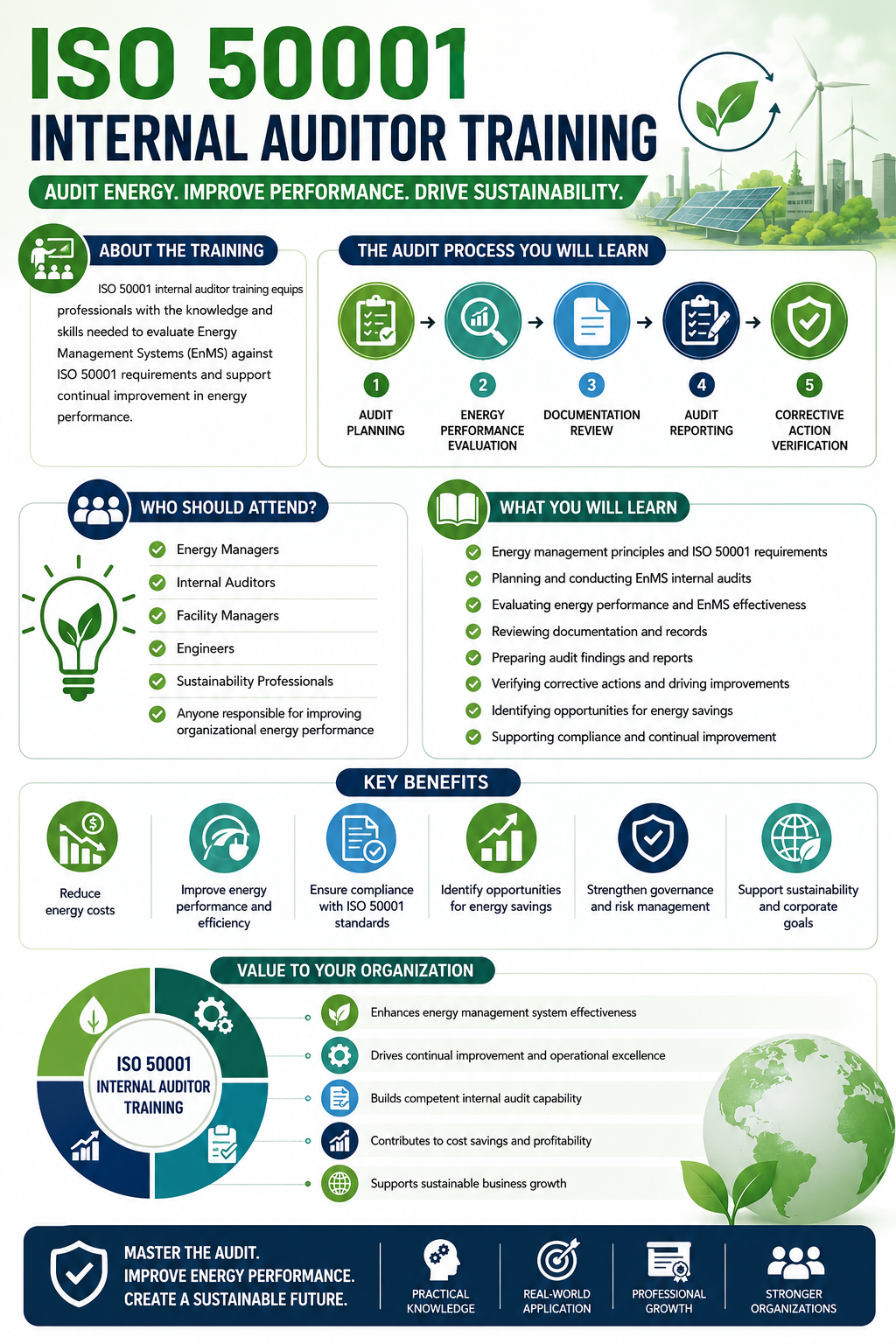
ISO 50001 Internal Auditor Training provides professionals with the knowledge and practical skills required to conduct internal audits of Energy Management Systems. The training helps participants understand ISO 50001 requirements, evaluate energy performance initiatives, and support continual improvement efforts. As energy efficiency becomes a key component of corporate sustainability strategies, trained internal auditors play an increasingly important role in organizational success.
1. What Is ISO 50001 Internal Auditor Training?
ISO 50001 Internal Auditor Training is a specialized course designed to teach participants how to perform internal audits of Energy Management Systems according to ISO 50001 requirements.
The training covers:
ISO 50001 standard requirements
Audit planning and preparation
Energy performance evaluation
Audit reporting techniques
Corrective action follow-up
Participants learn how to verify compliance, assess energy objectives, and identify areas where energy performance can be improved. The course combines theoretical knowledge with practical auditing exercises to develop effective internal auditing skills.
2. Key Benefits of ISO 50001 Internal Auditor Training
Organizations and professionals gain significant advantages from ISO 50001 Internal Auditor Training.
Major benefits include:
Improved energy management knowledge
Enhanced auditing capabilities
Better compliance with energy regulations
Reduced operational energy costs
Support for sustainability initiatives
Increased organizational efficiency
For professionals, the training strengthens auditing competencies and enhances career opportunities in energy management, sustainability, and compliance functions.
3. Who Should Attend ISO 50001 Internal Auditor Training?
The ISO 50001 Internal Auditor Training course is suitable for individuals responsible for managing, monitoring, or auditing energy performance within their organizations.
Ideal participants include:
Energy Managers
Sustainability Professionals
Internal Auditors
Facility Managers
Environmental Managers
Compliance Officers
Operations Managers
Organizations implementing ISO 50001 often encourage cross-functional team members to attend training to improve awareness and support energy efficiency initiatives.
4. Energy Management Trends Influencing Audits in 2026
Modern energy management systems are evolving rapidly due to technological advancements and sustainability commitments.
Current trends impacting ISO 50001 Internal Auditor Training include:
Smart Energy Monitoring Systems
Organizations are deploying IoT-enabled sensors and smart meters to collect real-time energy consumption data.
Artificial Intelligence for Energy Optimization
AI-driven platforms help identify inefficiencies and recommend energy-saving opportunities.
Net-Zero and Carbon Reduction Programs
Many businesses are integrating energy management systems into broader environmental sustainability strategies.
Renewable Energy Integration
Organizations are increasingly adopting solar, wind, and other renewable energy sources to reduce carbon emissions.
Professionals completing ISO 50001 Internal Auditor Training gain insights into how these trends influence energy management audits and performance evaluation.
5. How ISO 50001 Internal Auditor Training Supports Certification Success
Internal audits are essential for maintaining an effective Energy Management System and preparing for certification audits.
Through ISO 50001 Internal Auditor Training, participants learn how to:
Develop audit checklists
Gather objective evidence
Evaluate energy performance indicators
Identify nonconformities
Verify corrective actions
Well-trained auditors help organizations maintain compliance, achieve energy objectives, and demonstrate continual improvement during external certification assessments.
Conclusion
Energy efficiency and sustainability have become critical priorities for organizations seeking long-term success. ISO 50001 Internal Auditor Training equips professionals with the expertise needed to evaluate Energy Management Systems, identify opportunities for improvement, and support compliance with international standards. As businesses continue to focus on reducing energy consumption and achieving environmental goals, skilled internal auditors will remain essential for driving energy performance excellence and sustainable growth.



Write a comment ...